
In her masterful debut, The Melancholy of the Tongue (Fidessa Literary), Genevieve Asenjo stitches together a narrative set against the vibrant yet complex backdrop of Antique, Philippines. The novel follows its protagonist, Sadyah, on a journey of self-discovery that untangles the threads of history, family secrets, and the profound, often melancholic power of language.
In this Q & A with The Filipino Expat Magazine, Genevieve reflects on the artistry behind her protagonist’s journey, the evolving meaning of “joy”, and the quiet, persistent power of the mother tongue to unlock the most guarded chambers of the human heart.
TFEM: Who was the primary inspiration behind the main character, Sadyah?
Genevieve: This is my first novel, and it contains many facts from my own life. A diligent reader like you or a literary historian could verify some of them: the schools I attended, the town where I was born and grew up, the landscapes that shaped my imagination, and certain memories. I did not feel the need to conceal these origins. We always start from the self; from what we know, and writing is an exploration of making sense. Thus, in the process, I realized —and I would like to believe this is true for any writer —that the facts of the self are merely a point of departure. Once remembered, imagined, and speculated, the self enters into conversation with other lives: it becomes part of a bigger narrative, say the life of the community and the nation.
TFEM: Sadyah’s name beautifully mirrors her duality. Sadya which means “joy” in Kinaray-a & Hiligaynon and “purpose” in Tagalog. Was this intentional character design to reflect her internal journey of finding “purpose” through “joy” despite the weight she carries?
Genevieve: Thank you for this thoughtful question. Indeed, readers can discover meanings before the author does!
The Tagalog meaning of sadya, which is purpose, had —strangely enough — escaped me. It took your question to make me see it. For a long time, from the novel’s inception, from 2006 (I finished it in 2008, and first published in 2010) to date, I was occupied with sadya as I knew it in Kinaray-a and Hiligaynon, two major languages of my home island, Panay, in the Western Visayas region of the Philippines. Yes, sadya is joy, delight, celebration: a word that belongs to the emotional landscape of my childhood on the farm.
Yes, very much. I have always believed that names carry stories, and sometimes, destinies. When I named her Sadyah, with an h, I was thinking of redemption. I was thinking of a young woman born into histories she did not choose, yet determined not to be imprisoned by them. I was certain to offer her the possibility of becoming more than the stories handed down to her.
Looking back now, I realize that indeed, Sadyah moves between both meanings of the word. Between joy and purpose. Between what is given and what is chosen. In this sense, her purpose becomes inseparable from joy — not happiness in the simplistic sense, but the deeper joy of self-knowledge, freedom, and belonging.
Again, maraming salamat dito.
TFEM: The Melancholy of the Tongue masterfully blends history, romance, family drama, and political tension. From a craft perspective, how do you approach balancing these heavy, disparate threads without losing the narrative pulse?
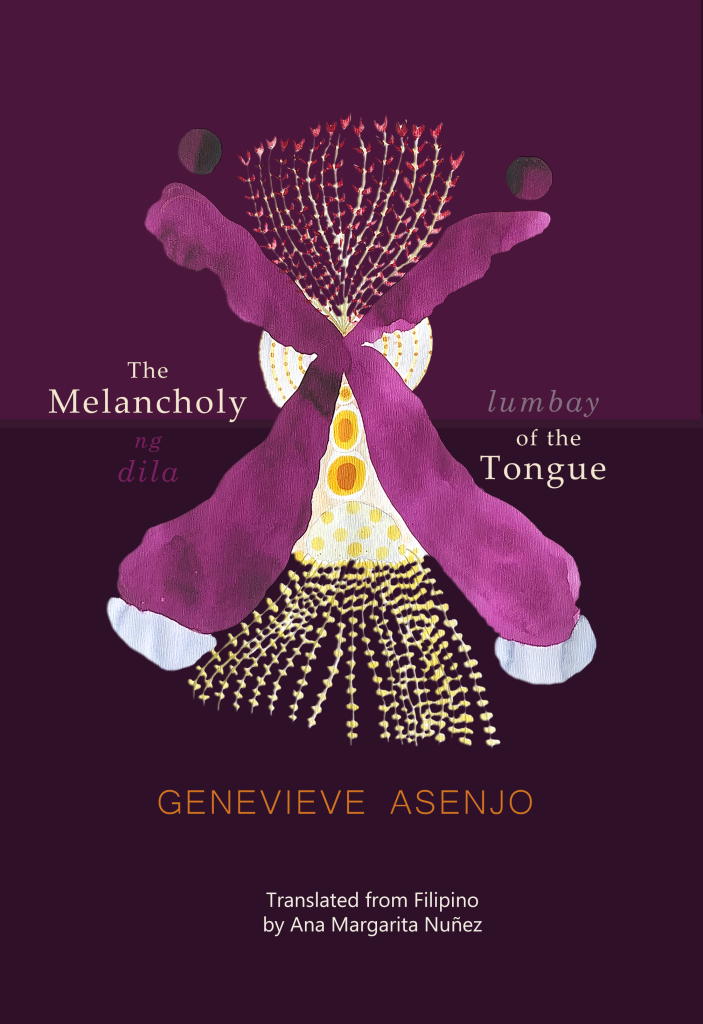
Genevieve: I never experienced these elements as separate threads that required balance. To me, they were always part of the same fabric. I think this is why, in the second edition, the 2020 cover of Lumbay ng Dila, designed by the publisher Ronald Verzo of Isang Balangay, featured a stitched artwork by Mary Ann Jimenez-Salvador, and felt immediately right. Ronald understood something essential about the novel: history, romance, language, family, and politics — they are entangled in Sadyah’s life.
From a craft perspective, what I was obsessed with then was to inhabit the bigger stories in the personal, in the domestic intimacies of our everyday life: the First Quarter Storm or the Martial Law in the 1970s: how this story of a country becomes a family story outside of Manila: the political rivalries in our province Antique, the story I grew up with about this period from my grandparents. So, in this novel, they begin with the people who become my characters: Sadyah’s grandfather, Marcelo Lopez, and her revolutionary parents, who would fuel her search for truth: what really happened?
TFEM: You anchor key meetings between Sadyah and the men in her life. Stephen during a flooding, Ismael when it was drizzling, and Priya, in the middle of a storm, all in distinct meteorological states. Does rain represent a cleansing force, a harbinger of turmoil, or perhaps the fluid nature of truth itself?
Genevieve: Again, thank you for your sharp and interesting reading. I did not consciously set out to make rain a symbol, and again, perhaps this is another case of writers rarely knowing what the weather is doing in their work until much later.
The Philippines, being an archipelago with an average of 20 tropical storms each year — a drizzle, a storm, a flood — they are part of daily life. In the novel, weather is not merely background or context; it reveals character and moves the story forward, as in the case of Sadyah and Stephen: will he come or not come, and bring her something to eat during the flooding? A test of character, also revelatory of the Filipino’s romantic imagination: we lean toward grand or epic gesture as proof of love. In Priya’s case, the weather quite literally brought them together. A pair of Levi’s jeans hanging on Sadyah’s condominium balcony was blown by the wind to Priya’s balcony, creating the occasion for their first encounter. This scene was inspired by a colleague’s story, lamenting the loss of her beloved pair of jeans to the storm’s wind. The romance that follows is fiction — as they say, the truth of fiction is the truth of probability. I had fun writing these scenes.
TFEM: Sadyah’s romantic life is defined by her relationships with a Chinese, a Muslim, and an Indian. Does this configuration serve as a deliberate historical resonance, echoing the pre-colonial Philippines when trade and cultural exchanges with these specific civilizations first shaped our identity? Was this a conscious effort to reconstruct the “original” multicultural landscape of the archipelago through your characters’ hearts?
Genevieve: Absolutely. The Philippines did not begin with colonization. Long before Spain, the islands were already connected through trade, migration, and cultural exchange. Chinese, Indian, Arab, Malay, and other influences shaped who we are.
I wanted Sadyah’s intimate life to embody this. Her relationships are not only romantic; they are encounters with and within the multicultural, multilingual Philippines and even beyond (there are scenes set in Bangkok, Thailand—the first country outside the Philippines I’ve traveled to). The novel interrogates the idea of a singular Filipino identity because such an identity does not exist.
This was a conscious decision, the novel being a creative dissertation. I was interested in exploring, and executing through fiction the underrepresented contemporary Philippine realities: the robust and dynamic presence of Chinese Filipinos, Filipino Muslims, and Indians (among many other foreign nationals studying in the Philippines): relations, crossings, exchanges. And I believe, they are often experienced most intimately and powerfully, through love.
TFEM: History and literature have often relegated women to the role of the “muse.” In writing Sadyah, how did you consciously work to position her as a critic of her world rather than merely an object of inspiration?
Genevieve: I grew up in a family where women held authority: they kept the purse, made decisions, and farmed and raised pigs and chickens to augment income while we were in college. The men, at least in my maternal side of the family, are uncles who are drunkards who cry when their wives are off for a vacation in Manila. So, the idea of a strong, independent woman never struck me as unusual. It was simply the world I knew.
So Sadyah’s strength was never the question; it was about what she wanted to know. What’s the truth behind the accusation against her grandfather as the murderer of his political rival, the celebrated kocal hero? Why did her mother, Teresa, abandon the mountains and the revolution, yet never return for her?
The novel begins here, and as it progresses and Sadyah unravels the truth, another question arises for her: now that you know the truth, what will you do with it? There is an answer somewhere in the novel that the reader can either agree with or disagree with, of course.
In this sense, Sadyah is not a muse. She is an investigator: she becomes the center of the novel not because history happens to her but because she is persistent – with her lovers Stephen, Ishmael, and Priya —on understanding it. She is a reader of people, of history, of herself.
TFEM: The book touches on the “culture of the dole-out”, a cycle of dependency. Do you believe literature and art have the power to shift this collective mentality, or are we destined to remain tethered to these systemic habits?
Genevieve: As an academic, we see creative writing as scholarship. Literature can aid policy reform or demand political accountability. I hope that, through this novel, we can better understand why certain conditions persist. Why dependency, loyalty, gratitude, resentment—such as Manila-province inequality or tension — and most of all hope become entangled in everyday life.
Through Sadyah and her relationship with her Auntie Fely, I wanted to explore, if not reveal, the emotional life of rural Philippines, and in this case, Antique in Western Visayas: the ways power is experienced not as an abstract structure but through relationships, favors, debts, kinship, affection, and memory. Most of all, the habits of care that might have become ordinary or taken for granted, such as in her Auntie Fely’s expectations of her now that she is a successful professional based in Manila. In short, my concern was more about revealing habits, assumptions, and emotional arrangements that we consider for natural or even good and now has to be examined, or perhaps, returned to.
TFEM: You highlight how language acts as an emotional key: English/Taglish provides distance, while Kinaray-ah and Hiligaynon bring Sadyah to tears, touching her soul. Why do you think our native tongues possess the unique power to unlock our most guarded vulnerabilities?
Genevieve: Because mother tongue is the language of primal thoughts and emotions. It is the language of our first experiences. My earnest prayers are still in Kinaray-a, so are my deepest sorrows and pains. It’s like calling out for “Nanay” (Mother).
A language is never only a language. It is also a history of feeling. Our emotional archives.
For instance, the Tagalog lumbay is not simply sorrow. We agreed (with the translator Ana Margarita Nunez) that melancholy is more encompassing and enduring. It is not only a feeling but a condition. A disposition. An affliction one carries, sometimes knowingly, sometimes not. It lingers beneath ordinary life, shaping how one remembers, desires, loves, and understands the past and envisions the future. Lumbay, melancholy, is in the body.
TFEM: You write that “freedom is the gift of truth,” yet acknowledge that some skeletons must remain buried for the sake of survival. If every hidden truth were suddenly exposed, do you believe society would be liberated, or would it simply collapse under the weight of its own past?

Genevieve: Both are possible. Truth is not only liberating, it can also be devastating. Nevertheless, we seek truth because concealment has its own consequences. Silence takes shapes or scars us in other forms. So, we have two tasks, actually: to know the truth, and to bear it.
It brings us to more question then: How ready are we? Can we live with the truth? Or how do we live with the truth, or truths?
I think The Melancholy of the Tongue shows a way.
TFEM: At the core of the conflict in your book, one must ask: Do you believe people are inherently inclined toward goodness, or is “good” simply a construct we use to survive one another?
Genevieve: I have become wary of simple moral categories. I do not believe people are simply good or bad. Most of us live somewhere in between. In social media, you see, hear, read people defend those who were good to them even if they are accused of corruption or sexual harassment. My beloved wise mentor, National Artist for Literature Cirilo F. Bautusta has a poetry book titled Believe and Betray.
So being good is something we aspire for, manifested in continuously doing it in both small and grand acts. Sometimes we fail, and that’s where vulnerability and being human come in, being imperfect. The most important thing is our willingness to choose it, like, everyday, or most of the time, especially when it matters most. So, like love and many other else in our lives, being good is a choice, a decision.
TFEM: When a reader closes the final page of Melancholy of the Tongue, what is the lingering feeling or the specific question you hope remains in their mind?
Genevieve: Sadya. Saya. Joy. I hope for my readers the reading pleasure of language, of story, of entering lives, histories, and aspirations larger than one;s own.
I hope my readers in diaspora leave with a sense of redemption through a deeper understanding of our pasts. A renewed pride in who we are, what we have endured, what we have created, and what we might still become.
I am remembering a beloved Filipino image: that of bukang-liwayway – the coming of dawn. Persistence and faith that morning will arrive after a storm. Or as my mentor elegantly put it, a title of his another major work: Sunlight on Broken Stones.
TFEM: You explore the concept of gahum (power) within the context of revolutionaries. What is your personal gahum, the source of power that fuels your own writing and persistence?
Genevieve: I would like to believe I am both grounded and cosmopolitan, and I think curiosity plays a big role. Curiosity carried me across islands and continents. It allowed me to listen to stories in kitchens, dining tables, cafes, classrooms, conferences. It brought me friendships and yes, enduring romance.
With curiosity, I have persistence. I have been described as such several times, by different people, both in personal and professional situations or moments. So I think these are my gahum or power (in Kinaray-a and Hiligaynon, gahum suggests spiritual power, mythical energy): sustained attention and care, which in return, sustains me as well. I have my sorrows and battles that keep me humble but graces abound, and I am grateful.
The Melancholy of the Tongue will be officially launched in Barcelona, Spain on June 27, 2026 (4:00 p.m.) at The Philippines Club, Pasaje de Madoz, 5, Barcelona.
What's Your Reaction?