
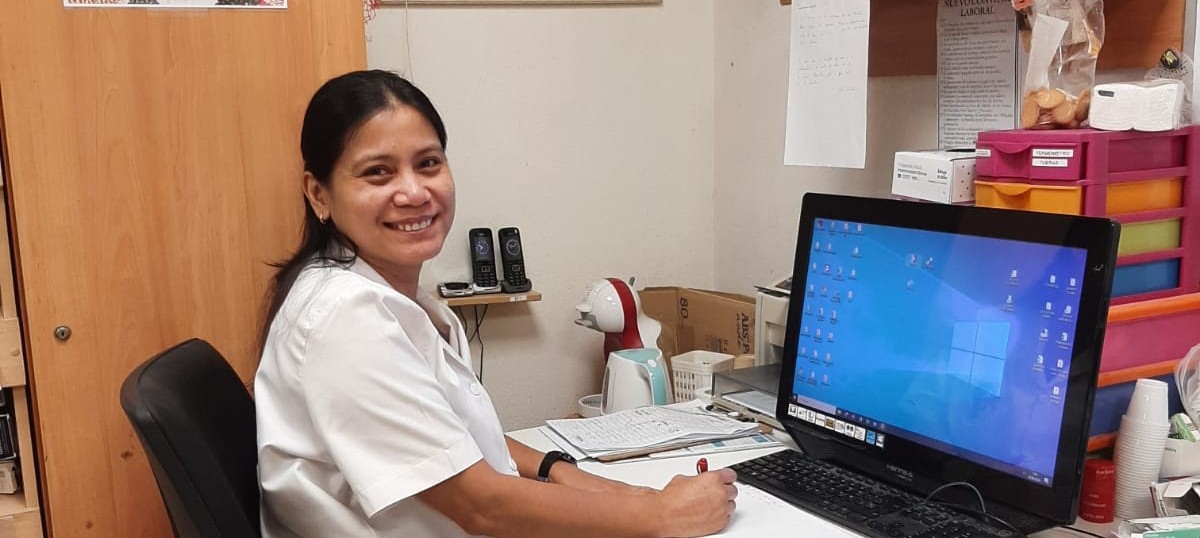
“And what is your criteria to refer this patient?!”
The annoyed voice of the doctor on the other line makes Lyn´s heart pound. She glances at the piece of paper in her hand and recites everything again. That the patient is having severe abdominal pain, chills and fever. What else can she say? She has already described every detail of the symptoms. But the doctor still seems unconvinced. “But it is not sufficient! Are you really a nurse?!”
Every time Lyn Oamil Tagorda, 43, shares this anecdote, she can’t help but laugh out loud. “I used to dread calling the hospital to refer a patient. I would first write down what I had to say before calling the hospital. My Spanish was awful and the doctors were very intimidating.”
So what did she tell the doctor?, I ask her during our interview in her flat in Barcelona. “I passed the phone to my head nurse to convince him. And our head nurse would tell me, Lyn, this is not how you do it, eh.”
In the middle of 2020, when Spain opened its doors to foreign nurses living in the country to counter the effects of the dwindling numbers of frontliners during the height of the pandemic, Lyn was one of the very few Filipino nurses who got hired to work in nursing homes in Barcelona.
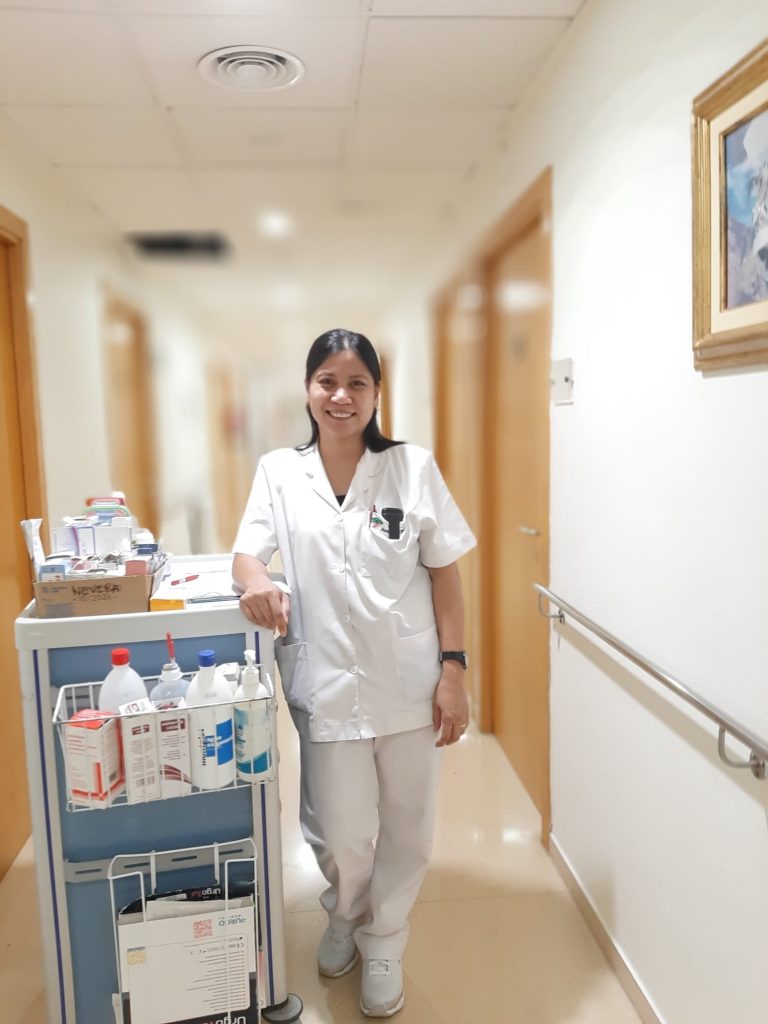
A native of Sto. Domingo, Ilocos Sur, she initially studied medical technology in college but later switched to nursing. In 2005, she completed her degree at Pines City Colleges in Baguio.
She passed the nursing board exams a year later and worked as a staff nurse at the Las Piñas University of Perpetual Help in Parañaque.
Her life took a sudden turn when she got pregnant, and eventually tied the knot with her husband, Jason. Months into the marriage, Jason decided to seek employment in Spain with the help of his aunts who were already residents of Barcelona. A year later, Lyn and daughter Katrina joined Jason in Spain. Aware that language barrier and cultural differences would pose significant challenges in pursuing a nursing career in Barcelona, Lyn decided to set it aside and instead, worked as a cleaning lady for a Catalan family.
The homologación process
In 2012, a Filipino nurse friend Sharohl Alcedo encouraged her to do the homologation of her documents. Sharohl, 49, came to Spain in 1999 and started her homologation process in 2000. She got certified two years later. Homologation or “homologación”, is the official validation of a higher education degree obtained outside Spain. It is the process by which the Ministry of Education and Professional Training recognizes the degree obtained abroad and makes it official and fully valid for legal and professional purposes in Spain. The process can take one to two years or more, and can cost more than 1,000€.
Lyn requested her mom in the Philippines to gather the required documents. Unfortunately, the documents were insufficient and were rejected by the Ministerio de Educación. Discouraged, Lyn had to set aside her desire of a nursing job one more time. Until Jason suggested she try her luck outside Spain.
In August 2013, with the help of a college classmate, Lyn flew to Vancouver, Canada. But the promised stay-in caregiver position, as stated in her contract, turned out to be a scam. Fortunately, another college friend came to her aid, providing temporary shelter and assistance in finding employment. She was eventually hired as a caregiver for 10 CAD per hour, working alongside a registered nurse.
While trying to survive in Canada, Lyn´s family was having a tough time in Spain.“Jason suffered a motor accident while Katrina had multiple accidents at school.” She also realized that she couldn´t afford the 10,000 CAD cost to be a registered nurse in Canada. She decided to come back to Barcelona in December 2013, resuming her previous job as a cleaning lady. Although working as a nurse still seemed a long shot, Lyn decided to submit her documents for homologation the second time around in 2020, very careful not to repeat her previous mistakes.
Finally, a door opens
When COVID-19 happened, Lyn found herself unemployed. One day, she got an unexpected call from her friend Sharohl Alcedo, a Filipino nurse who has been working in a Care Home in Barcelona for years now. She was asking for Lyn´s CV. A nursing home was badly in need of nurses, she told her. Lyn was called the next day for an interview.
I told them my homologation was still being processed. I was honest to them, telling them that it had been 6 years since the last time I worked as a nurse. And that my Spanish was not that good.
Lyn Oamil
Despite her lack of recent nursing experience, Lyn got the job and was asked to report for duty the following day. According to the government policy, once you have submitted the documents for homologation, you can start looking for a job in healthcare. “I was nervous! It was really happening. after all these years!” Before starting her first day, she reviewed essential medical procedures, such as taking blood pressure and temperature.”
On her first day, Lyn shadowed her senior nurse as her orientation. “The building has five floors. Each floor has 27 rooms and each room has either one or two patients. I am in charge of three floors together with another nurse. The first thing I have to do is to check the patients´vital signs. With three floors and approximately 200 patients for two nurses, it was a struggle to manage at first. It was physically and mentally exhausting.”
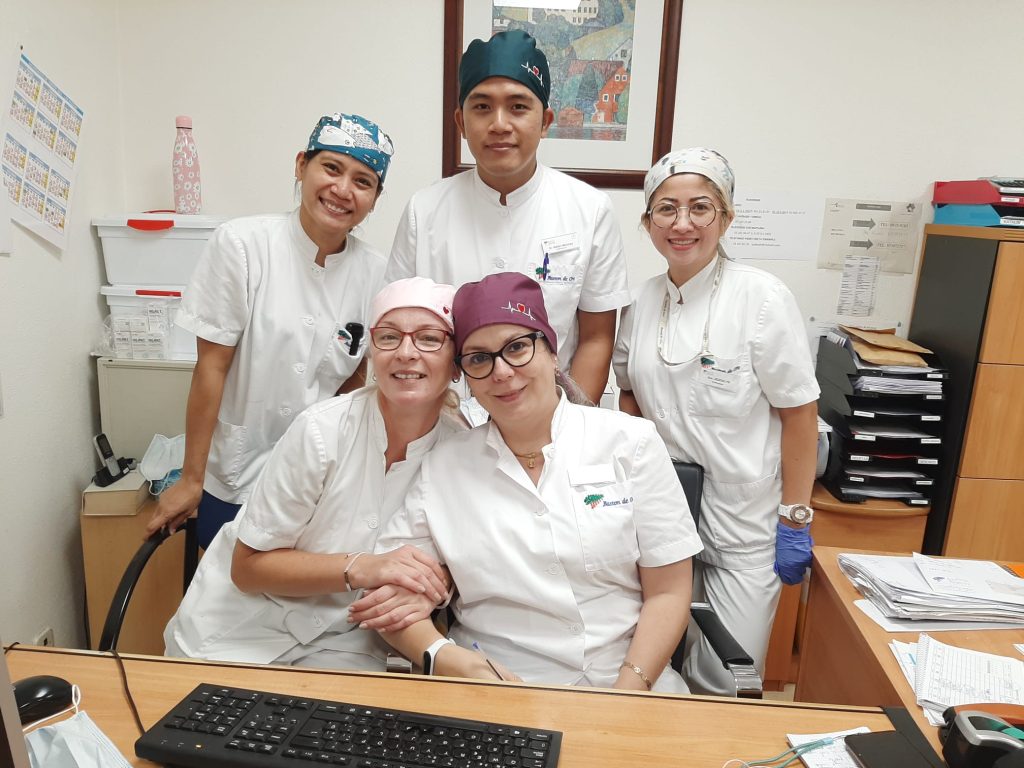
Most of the patients have dementia, alzheimer, epilepsy and heart problems. “The first time the patients saw me, they were curios.” Lyn apologized for her Spanish. Don´t worry, we will help you, they told her. Lyn felt relieved realizing that it wasn’t all about fluency,, but about the connection she had with them.
Although she already knew the emotional toll of her job, witnessing a death of a patient is deeply distressing.
The first time my patient died on my watch, I felt a sense of guilt and self-doubt, could I handle the emotional demands of my job?
Lyn Oamil
Three months later, she wanted to quit. “Not because of my workload but because of my work mates.” Lyn confesses that the first months were a challenge for her. “As I couldn´t express myself that well in Spanish, some of them were already insulting me right in my face.I felt stupid, left out.” Over time though, Lyn has become more aware of subtle insults, cultural jokes and disrespectful remarks. She has learned to answer back and gradually, she gained confidence and has become more comfortable handling tough situations independently.
Lyn´s Spanish and her work relationship with her co-workers improved, making her start to love her work. She now finds talking to a doctor on the phone to refer a patient less daunting. One of the most heartwarming aspects of her job is the genuine appreciation shown by the patients and their families. “They often refer to us carers as family members. Especially for patients who are without children, we become their primary source of companionship.”
It all takes “lakas ng loob”
Before the pandemic, there had only been very few Filipino nurses who had penetrated the Spanish healthcare. Ironically, now that Spanish hospitals and nursing homes have began accepting Filipino nurses, still a small number has grabbed this opportunity.
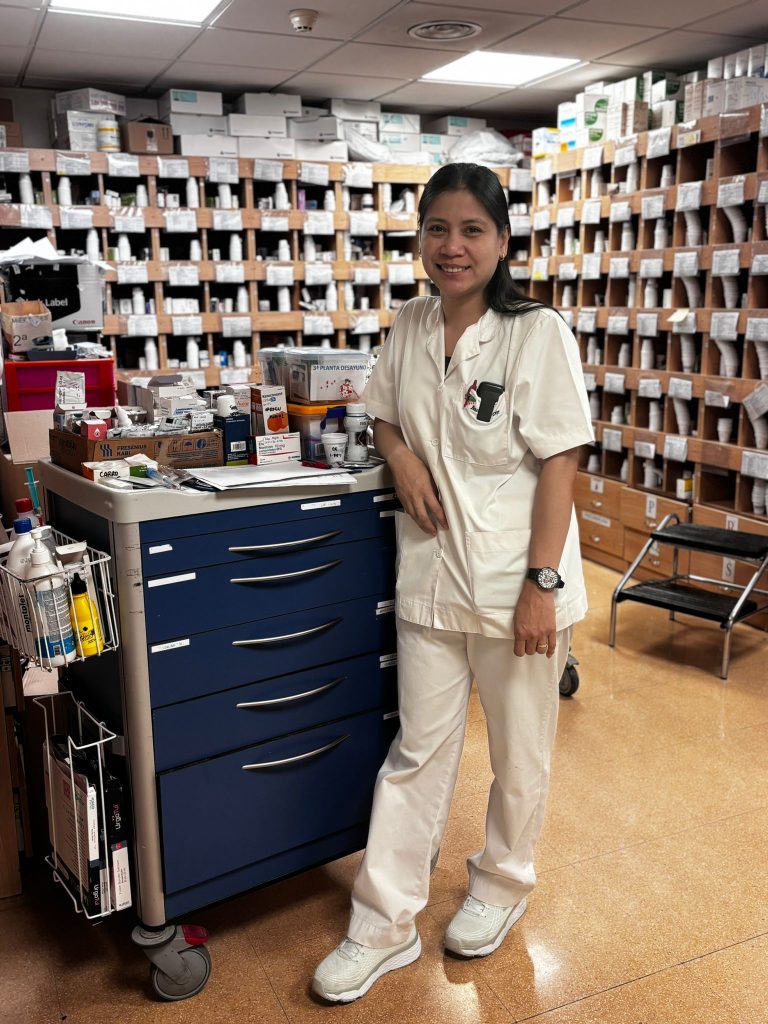
“Most Filipino nurses already have regular jobs in restaurants and houses, and no longer keen on going through the long process to be certified nurses in Spain,” shares Sharohl, who is now a head nurse and sanitation manager. She is also one of the advisers of the Filipino nurses group in Barcelona which has 296 members. According to her, there are only around 10 Filipino nurses who are now employed in nursing homes in Barcelona, and one or two in hospitals. “There is also this misconception that working in nursing homes is like working as a caregiver, which is totally untrue,” explains Lyn.
Marie, 46, a licensed nurse in the Philippines but works as a waitress in Barcelona, no longer plans to go through the homologación process. “I have to ask a favor from someone in Manila to get my Transcript of Records, diploma, syllabus and then to be certified, authenticated and verified by the CHED, and apostlilled by the DFA. And then translate them into Spanish by an official translator before submitting to the Mnisiterio de Educación. I also have to pass the language proficiency B2. It cost a lot of money and time. I am rusty now. I haven’t held an injection in years!”
Pursuing a career in nursing requires a significant amount of sacrifice and dedication. The cost of homologation, the process of validating foreign nursing credentials in Spain, combined with the challenges of adapting to a new culture and language are the hurdles that a Filipino nurses should overcome.
“It really takes lakas ng loob and a long term plan,” explains Lyn.
I found my work rewarding. The sense of accomplishment that comes from helping patients is invaluable.
Lyn Oamil
Because of her impressive performance, Lyn has been considered for a higher position this year. But she politely declined, saying that she still needs more years of practice and experience. “God gave me this job because He knew I could do it,” says Lyn, who remains hopeful that in the future, there will be more kababayans working in Spanish healthcare.
What's Your Reaction?