Growing up in a religious home in Bacolod, Holy Week felt like the world had stopped for a couple of days, hitting a “pause” button. A week of deep, sacred silence. Starting Holy Thursday, the usual noise of kids playing was replaced by a heavy, solemn atmosphere. In our household, shouting or rowdy play was strictly forbidden. Don´t make noise! We should be mourning, my nanay always reminded us.
We would spend hours listening to vivid dramatizations of Bible stories and the Passion of Christ. Meat was absent. My Nanay would boil saba for our afternoon snack. Even now, this taste evokes the stillness of our Holy Thursdays and Good Fridays where I would lie down beside the radio.
Good Friday was the quietest of all. After 3:00 PM, the hour Jesus died, we stayed perfectly still. Don’t get wounded today, for it will never heal, we were warned. In the evening, we would head to the public plaza to watch the long, flickering candlelit processions.
When I moved to Europe 22 years ago, I began looking for that same spiritual feeling in new places. I traveled across Spain, from the southern cities of Sevilla, Málaga, and Córdoba to the north, Salamanca and Zamora, to experience the grand processions and the locals´ deep devotion to the Lenten Season.
Today, living in Catalonia, I have started a personal tradition of going to Sant Hilari Sacalm on Holy Friday to watch the re-enactment of the Passion of Chirst.
While the “no movement no noise” rule of my childhood might seem dated now, the values of reflection and family remain. To see how these traditions have survived the diaspora, I reached out to some of my friends living in different corners of the globe.
I asked them about the memories they carry in their hearts and how they keep the spirit of the Filipino Holy Week alive, thousands of miles away from the plazas of their youth.
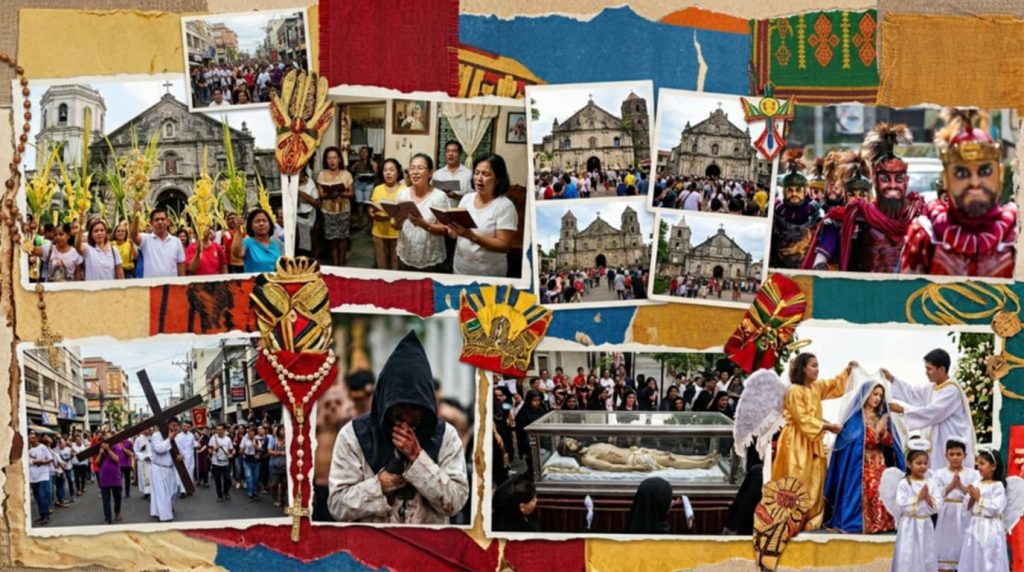
I started with my kababayans in Spain. May Imperial, who has lived in Spain for 26 years, vividly remembers the Pasyón, the Passion of Christ. “What I remember from my childhood is that we used to read the book of Pasyón, the act of reading and chanting. The elders used to tell us not to bathe and not to get injured because Jesus Christ died on Good Friday.” Her mom is still keeps reading the Pasyón book even now. Today in Barcelona, May joins the Via Crucis organized by the Filipino Parish in Barcelona on Friday and stays home in reflection on Black Saturday. On Easter Sunday, she goes to mass to celebrate Christ´s resurrection.
Badeth Ramos, living in Spain for almost two decades, recalls the lighter side of these traditions. “The most memorable and so far the funniest was every Sabado de Gloria (Black Saturday). My mother would always tells us to jump! Jump! And jump! the first hour in the morning for us to grow taller!” Her mother would then cut their hair, “Because it was said that it grows back faster if cut on Black Saturday.”They would later butcher a pig and bring it to the beach.
Although she can´t butcher a pig in Spain or no longer jump to get taller, Badeth makes it a point to celebrate the Lenten Season going to mass and join the Via Crucis on Good Friday.
Alfred Jamin, who has lived in Spain for 13 years, reflects on a simpler shift. He remembers the consistent rhythm of attending mass and services as a child. Now living abroad, he finds that his devotion has become more private, spending the holy days reflecting at home.
Kristina Ibea, who has been living in Spain for 4 years, remembers doing Visita Iglesia with her family, going to different churches around Cavite. How excited she was eating street food in between churches. “I would then go to my grandparents’ house to meet with my cousins and my lolo and lola.”
In Spain, she attends the masses in her local neighborhood church especially on Palm Sunday, Good Friday, and Easter Sunday. “I also do the stations of the cross in my local neighborhood church during Good Friday.”

In Holland, Chris Sta. Brigida remembers a childhood on stage with Tanghalang Santa Ana. “Every year, the theatre group staged ‘Martir sa Golgota´, a play depicting the Passion of Christ.” He had the opportunity to take part in these performances for several years, travelling to different town halls across Metro Manila. “One of the highlights was perfroming at Plaza Hugo in Santa Ana, Manila. It allowed me to express faith through art at a very young age.” Now, after 25 years in Europe, his observance has become more solemn, quiet, and personal. “I attend church and spend time in prayer. My prayers are always centered on my parents and family back home, which keeps me spiritually connected to them despite the distance.”
Chef Eric Layno also recalls Pasyon during his childhood days. “Everyone was encouraged to participate in the Pabasa ng Pasyon in my province. On Good Friday we would watch the Penitensya.” Penitensya is practiced by devotees as a way of repentance which includes walking barefoot and flagellating themselves for a certain amount of time in front of a viewing public. “And on Easter Sunday, in the early morning, we would participate in the final event Salubong.”
Based in Albania for years now, he celebrates with his family at home.
Dan Anthony Sisma, living in the US for 3 years, credits his grandmother, Abeth for exposing him to participate in religious activities. “My lola and I would wake up at 4:30 a.m. to go to church for the start of the Stations of the Cross. ”
It was his lola Abeth who taught him to be faithful and religious. For Dan, Holy week is about reconnecting and reflecting. “It was a time when my entire family came together. Those days were filled with faith, love, and a sense of togetherness as we honored the life, death, and resurrection of Jesus Christ.”
Moving to the US was a shock for Dan. “I immediately felt how different they celebrate Holy Week here. You don’t see processions passing through neighborhoods. Life continues as usual in Holy Week. People go to work, and businesses remain open. But despite the difference, Dan´s faith and devotion remains intact. “My faith has become more personal. Here in the US, I find my own ways to reflect by spending time in silent prayer, revisiting the meaning of the season in a more intimate way.” He watches the Seven Last Words on YouTube. “Even if I am away from home, I feel a sense of familiarity.”
Reny Adrian Agustino, an 18-year resident of the US, remembers the colorful Moriones Festival in Mindoro. Centurion (Moriones) is a Holy Week celebration where locals dress as Roman soldiers to reenact the story of Longinus, a blind centurión who regained his sight after piercing Jesus´side. Reny can´t forget the strict rules of his lola on these holy days. “My grandmother forbade us to take a bath or laugh from 3:00 p.m. of Maundy Thursday until Black Saturday because Jesus is dead. We would also skip meat on all the Fridays of Lent. We also had to attend the Palm Sunday, Maundy Thursday, and Easter Sunday masses.”
Today, since Holy Week isn’t a federal holiday in the US, Reny just go to mass on Palm Sunday and Easter Sunday.
Melanie Martinez Thorup, living in the US for 15 years, recalls having time off from school and going on beach trips with her family and cousins in Holy Week. “It was a mix of simple but special moments like grilled pork chops by the beach, fresh fruits, and just spending the whole day swimming and playing.” Eventhough it felt like a vacation, there was still that sense of it being something sacred. “It was a time to slow down, be with family, and just reconnect. And of course, we would go to Easter Sunday mass.”
Now with two young children, Melanie tries to balance the American “Easter Bunny” with the Pinoy Lenten tradition. “Honestly, it´s a little challenging to keep the traditional practices. For my kids, Easter is mostly about egg hunts and fun activities.” Despite this, Melanie really wants to be more intentional about teaching her kids the real meaning of Easter. That it’s about Jesus rising from the dead, and what that means.”
Donna Zabala remembers her grandmother’s Pabasa. “She was the second voice and the older ladies would be at our home singing the Pabasa for the whole day. Or longer. It felt like forever! There was even an amplifier outside the house so all the neighbors could hear.” Her lola´s Pabasa only stopped when she got sick and so this family tradition died. On Maundy Thursday, her family would do the Visita Iglesia. “It was like a mini-outing for me and my family, and bumping into some classmates of friends in these churches was a fun bonus.”
Now based in the US for 22 years, Donna normally stays at home during the Lenten Season. “Kids have classes and I have to work. But we try to always go to church for Palm Sunday and Easter.” She and her husband also pop up a ‘Passion of Christ’ movie or anything religious for the kids.
In Germany, Pacita Henrich recalls the same heavy silence of the Holy Week. “We were reprimanded to behave because God is dead, so no one is there to protect us. We could only watch stories about God and the bible on TV. For us kids before, Holy Week was somewhat boring.” They were told to avoid getting hurt especially on Good Friday because the wound would take time to heal. We were not allowed to make noise, even sing!” On Good Friday, Pacita and her family would go to church to hear the Seven Last Words of Jesus. “It was really interesting how they dramatized it. You could feel Jesus´ agony.”
Here in Europe, Pacita observes that there are more Easter chocolates and bunnies. “Although in the more Catholic regions of Germany, they still observe the solemnity of the lenten season.”
Due to two bad mishaps which specifically happened on two Good Fridays, including a burglary and her car catching fire, Pacita now chooses to stay at home and go to church near her place.
If the Holy Week has a flavor, it is one of simplicity and sense of family. Elena Laddran, who has been in Kazakhstan for 19 years, misses the Binalay (sticky rice in banana leaves) of Isabela. “It became a small but special tradition that marked the Lenten Season for me. Even without big activities, that time at home, sharing food, made Holy Week feel significant.”
Living in Kazakhstan, Holy Week feels different. “Most of the time, I go to work during the week, and then spend the weekend at home, keeping the spirit alive privately. Elena spends the week in quiet worship. “I keep the reflective spirit in my own way like reading the Bible, singing praise and worship songs, and praying intimately.”
In the UK, Jason Go remembers their family tradition of going to church in his hometown Silay and wiping the feet of the statue of Chuirst. “And eating lots of suman (biko).” Now, he uses the time for a “restful holiday, mostly beach holidays around Europe.
Roda Naval Gregorius in Canada remembers the “joyride” of visiting 14 churches in a rented jeep. “We are having fun with friends, then we go serious once inside the church.” She has kept this practice alive abroad. “We try to continue the celebration by visiting at least 7 churches. We still go with a group of friends and have an itinerary to pray together.”
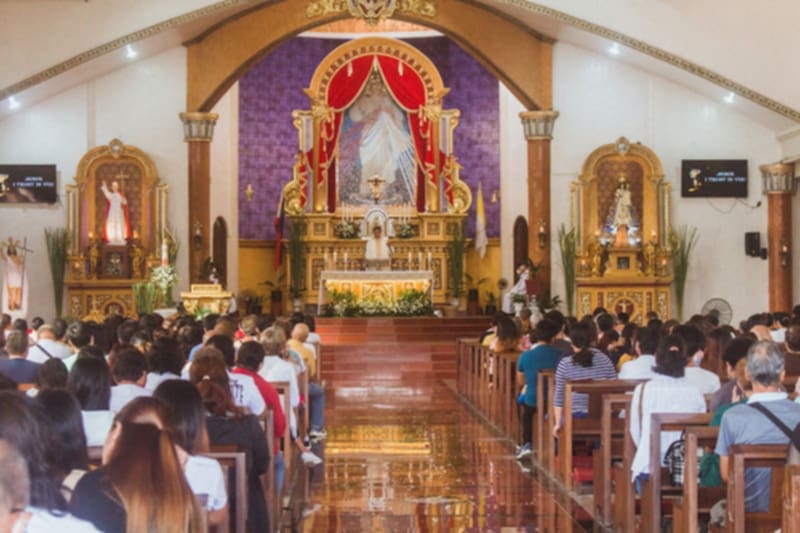
Mark Anthony Bonayon, living in France for almost 10 years, remembers the Holy Weeks of his childhood as family gatherings, shared meals, and the intense summer heat. His relatives would come over and they would feast together on simple traditional dishes like sinigang and paksiw na isda. “We would also try to keep quiet especially on Good Friday.” They would watch the Senakulo, a dramatization of Biblical stories that include the death and resurrection of Jesus Christ.
Mark Anthony admits that celebrating Holy Week away from home can feel lonely and incomplete. However, experiencing the processions in Málaga, Spain for the first time changed his perspective. “Seeing the beautiful processions, the solemn atmosphere, and the deep devotion can be powerful and moving. It shows that even far from home, faith can be expressed in different but equally meaningful ways.”
Jamcee Montero Napallatan, remembers the peace of the farm and the Holy Week processions in Pontevedra, Negros Occidental. “And since Holy Week in the Philippines always falls during summer break, my Papa would let me stay on the farm and spoil me to the max.”
During her eight years in South Africa, the tradition shifted to nature. “We did long road trips to Capetown and Durban from Johannesburg, and spend a lot of time in the sea or mountains.”
For Allan Calma, who has called Geneva home for the last two decades, the essence of the Holy Week is captured in a single, dramatic moment of dawn. “Salubong has always been one of my strongest and most vivid childhood memories,” Allan recalls. “It’s the Filipino reenactment of the meeting between the risen Christ and Mama Mary.” In the Philippines, Salubong is the climax of Easter Sunday, usually held while the world is still dark. Allan vividly remembers the theatricality that defines the Filipino faith. “I was always fascinated watching how a child, dressed as an angel, would be suspended in the air to remove Mary’s veil,” he says. “Holy Week was also a time for family gatherings, spending time with my cousins.”
Here in Europe, many of Allan´s friends observe Lent by fasting in their own way, whether by giving up meat, sweets, or something else they value. “It´s a personal sacrifice, something they chose to give up for the whole month as a form of reflection.”

A chance to breathe and reflect
It’s funny how memory plays tricks on us. Looking back, I can still feel that heavy, imposing silence that used to hang over everything during Holy Week. As kids, that quiet felt like a mix of dread and pure boredom, like the whole world had just been put on mute.
But now, those same memories actually make us smile. As we swapped stories about the “strictly no noise” rule and the endless afternoons, we couldn’t help but laugh out loud.
And behind our laughter, we know that these memories are part of what we have become. As adults, we have come to realize we actually need that silence. Holy Week gives us a chance to breathe and reflect.
It is also a time to reconnect with our faith. As what Sr. Paulita Astillero told me while we watched the Via Crucis in Sant Hilari Sacalm. “Holy Week is our way of standing in solidarity with Jesus’ suffering. Let´s be glad and proud to do that. ”
Happy Easter, eveyone!
What's Your Reaction?